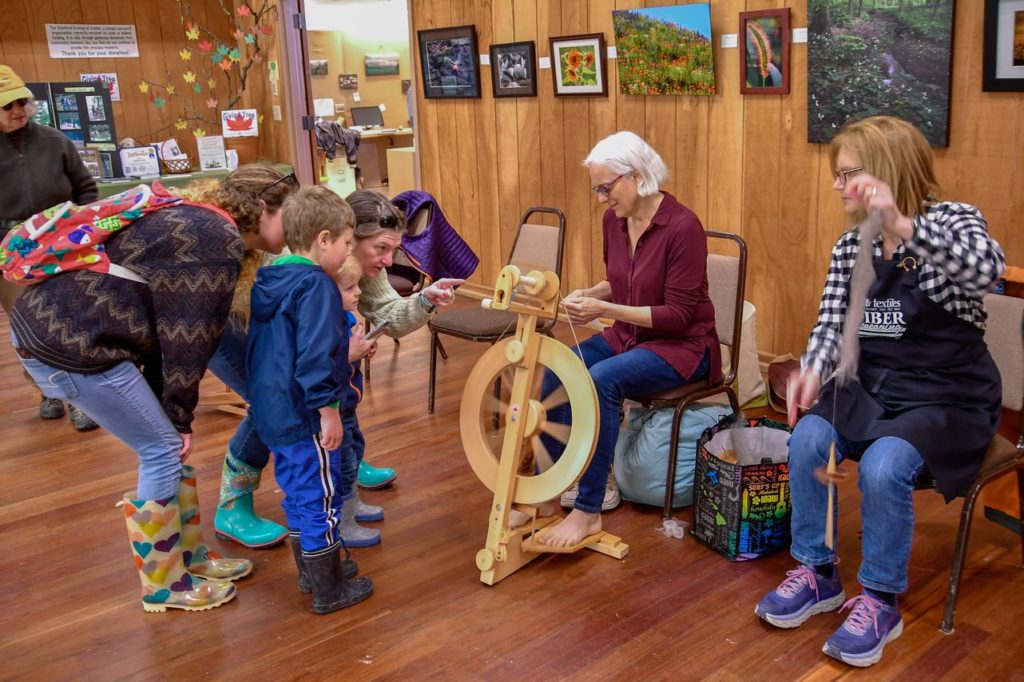
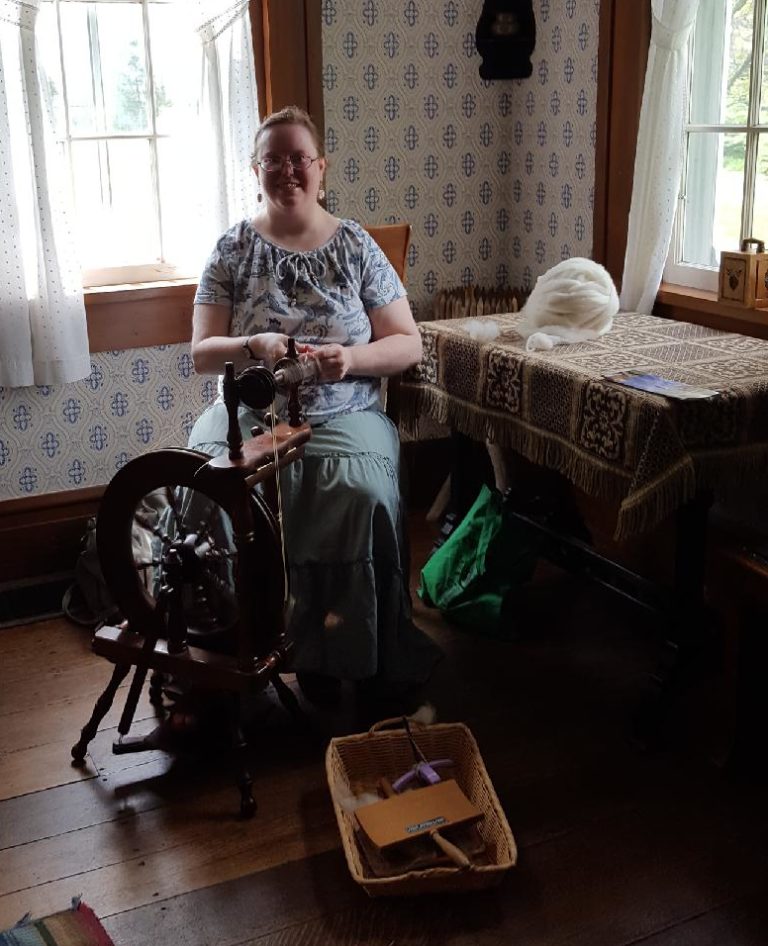
Members Julie (at the wheel) and Sue (with the drop spindle) talk about spinning to interested adults and children.
The Stratford Ecological Center in Delaware recently held their spring shearing day and invited us to demonstrate different aspects of processing that fiber into cloth.
The Stratford Ecological Center is a non-profit educational organic farm and nature preserve on 236 acres in Delaware County, Ohio. Visitors are welcome to explore the land, hike the 4 miles of nature trails, visit the livestock, tour the gardens and greenhouses or explore the creek, pond, prairie, swamps or State Nature Preserve. Farm products are available for sale seasonally, based on availability. Stratford offers workshops and classes for children and adults, annual festivals, farm tours, school tours, farm camp and family programs.
stratfordecologicalcenter.org
Our members enjoyed a day demonstrating spinning wool into yarn, while visitors could observe spinning, as well as DIY stations where they could try processing wool. The barn and farm were open for walkthroughs as well! Stratford was a wonderful host and we are excited to return for future demonstrations with their farm in the future!
There is something special about doing a spinning demonstration. Maybe it’s the fascination of the people who watch, commenting that it is so soothing to watch. It could be the eagerness of people from all walks of life and all ages to learn what exactly it is I am doing, and how the wheel works. I’ve always enjoyed teaching, and combining my passion with the ability to share something new with people just seems to make me feel good.
I have done a lot of demonstrations over the years I’ve been with this guild, in many different arenas: from the Brown Animal Building at the Ohio State Fair to an 1880s era farmstead at Slate Run Metro Parks. I’ll set up my wheel, take out my fiber – usually wool but sometimes alpaca – and begin to spin. I enjoy spinning for its own sake, but it increases my enjoyment to see people stop and watch. Some just stand there, enthralled by the action of the wheel. Some have questions, and I answer them to the best of my ability.
Whenever I go to a demonstration, I make sure that there will be a spindle or two about in case people want to try. I ask everyone who shows an interest whether they would like to try, and if they do, I’ll get them started on a spindle. Very rarely, they want to try on my wheel – and while some people I have noted do not want strangers to use their wheel, I don’t mind. This is probably because I’m right there, controlling the motion of the wheel itself. Only a very few people show any skill on the wheel, and those were people who are in contact with fiber anyway. One was a man who had practiced a lot on a spindle and was hoping to get a wheel, and another was a child who was around looms and wheels because his mother was involved in the craft.
If I can, I also bring a pair of hand cards, and if people are interested in the process of “sheep to shawl” I have these on hand to explain how the fiber gets organized after coming off the animal. While I don’t get these questions all the time, having the cards close at hand often brings up what they are and what they are used for.
This was supposed to be a little article about why I love demonstrating so much. I’m not sure I can answer that ultimately; I suppose it’s because spinning is one of my passions, and because of that I love sharing it with others. Most people see the fiber arts as a dying art, and I would like to see their view reversed. I love to hear that someone wants to learn to spin, because that means one more person in the world who knows it’s not a dying art, but one gaining in popularity.
Dori Smith, Guild Member
Editor’s note: See more of our members in action, please visit our Facebook page and click Photos on the left sidebar menu!
Every year our sheep to shawl experience is a bit different than before. This year we were lucky to feature wool from Susan Johnson, one of our Guild members who raises sheep at her farm, Blue Sheep Fiber, in Westerville. Susan donated a luscious white fleece from her Bluefaced Leicester ewe named Bumblebee.
Bumblebee’s wool became the weft for our shawl. Kim Johnson washed the fleece and Kathleen Craig carded it. The resulting fluff was soft and gorgeous, and the spinners created a beautiful yarn that Ed Morrow wound onto bobbins for Scott Hanratty to weave with. This year, we opted not to ply the yarn for the weft, and the beautiful singles yarn that our spinners created proved we made the right decision! Thanks to spinners Annette Dixie, Connee Draper, Inge Noyes, Joanne Knapp, Lori Seeger and Susan Johnson for stepping up to the challenge.
Scott Hanratty, Kathleen Craig, and Sue Briney prepared the loom. We choose pattern #727 from “A Weaver’s Book of 8-Shaft Patterns” by Carol Strickler. This pattern is very popular on the “Strickler in Color” Facebook page. It caught our eye and we opted for the straight treadling version in order to show off the warp. The warp was wound as a gradient, using 3 ends of 2/20 wool acting as one. We used 20 different colors in the warp, ranging from greys, pinks, maroons, browns, and even some orange. (One of the advantages of having a stash!) We gave Susan the option of picking the warp colors for her shawl, and she couldn’t decide. So, she ended up getting almost every color!
2018 Sheep to Shawl
The demonstration wouldn’t be complete without our terrific spokespersons who demo and educate the crowds who come to enjoy the show. Nicky Fried demo’d on the drop spindle and Kim Johnson brought her great wheel. Everyone enjoyed seeing different methods of spinning yarn and hearing their explanations of the process.
The folks from Malabar Farm Spinning and Weaving Guild joined us again, and this year they were using natural handspun for both warp and weft. They added a little Angelina when spinning their weft yarn to give the shawl a little glitz. Their weaver was creating a beautiful Leno shawl, which they plan to complete when they return to Malabar.
Thanks to Jon Briney for taking photos. We hope to have an updated Sheep to Shawl scrapbook soon to share at guild meetings.
On Sunday after the Sheep to Shawl demo, the hand spinning fleeces were judged at the fair. Linda Reichert won for the white fleece as well as the natural colored fleece. We gifted her with the second shawl (woven using commercial heather gray yarn for the weft) and the hand-spun, hand-knitted afghan that the guild created using natural colored fiber.
Guild member Sue Briney
Editor’s note: To see all the photos from this year’s Sheep to Shawl presentation, check out our Facebook page!
This spring’s fashion show theme was “Tea in the Rose Garden”. The fashion show was held at the Whetstone Park of Roses shelterhouse and while the day was chilly, the atmosphere inside was warm! There were dozens of door prizes awarded, delicious food from The Glass Rooster Cannery, and wonderful fiber arts projects to admire! See all the photos from this event in our Facebook album.
The Fashion Show would not happen without the efforts of our Fashion Show Committee members!
Event coordinators: Sue Briney, Kathleen Craig, Nan Hadley Raffle coordinators: Sue Atkins, Bobbi Rossin Registration: Jenny Becher, Georgene Lutz Table decorations: Cheryl Koncsol Photographer: Sue Atkins Non-wearables coordinators: Nancy Fischer, Linda Lehmkuhle, Linda Miller, Ed Morrow Wearables coordinators: Dawn Borror, Jann Offutt Models: Rachel Rossin, Emily Scullion, Lori Seeger, Julie Smith
Endless thanks go out to the businesses who donated prizes for our attendees!
Guild members Linda Hall and Sue Briney organized the Guild demonstration for Westerville’s Starry Night Family Learning Festival.
Sue and I had a grand time with wonderful guild members. Parents & grandparents were engaged & the students were curious & engaged. Everyone was very appreciative of our guild’s participation. One member brought her wheel & a sheep that baas when turned over. Just great fun.
Guild Member Linda Hall
Students had the opportunity to try weaving on tapestry floor looms, flat looms, and table looms. We also had a spinning demonstration and examples of all sorts of textile art!
This event had close to 2000 participants and great engagement at our booth!
Thanks to Starry Night for having us back again this year – we hope to return! For more information on Starry Night: Art & Science Fueling Imagination, please click here.
Thanks to our Guild member volunteer demonstrators as well! As you can see from the pictures below, demonstrations are an involved endeavor, requiring coordination and legwork to get the equipment and materials into the space! These demonstrations are a vital part of our mission to share the fiber arts with those who aren’t currently involved.
Central Ohio Weavers Guild (now Central Ohio Weaving and Fiberarts Guild) celebrated 80 years with an exhibit and subsequent book of its history told through documents, woven samples, connections to our national weaving history, a display of the Guild’s early loom, and 40 contemporary pieces woven by current members.
Our November workshop welcomed Lori Keller to share about her methods for Taking the Fear Out of Selecting and Processing Raw Fleece.
She shared different considerations to include when looking at the price of the fleece, questions to ask the shepherd and different aspects of the fleece that will affect prep time. Lori explained ‘skirting’ a fleece, advantages to doing it yourself whether you’re cleaning the fiber yourself or not, and brought in a few fleeces for us to practice skirting.
We passed around several samples of wool in various stages of processing: raw fleece, washed fleece, & carded batts Lori made on a drum carder.
We also were given samples of fleece to practice washing & rinsing using Dawn or Unicorn Power Scour so we could compare the products.
Lori demonstrated how to use hand combs for a more worsted-style fiber prep and hand cards for a more woolen-style prep. Lori also sent us home with samples to practice preparing and spinning!
Thanks to Lori for sharing all of her experiences with fleece with us!
As part of our 80th anniversary, COWFG attended the 22nd annual A Wool Gathering in Yellow Springs at Young’s Dairy on Saturday, September 16 and Sunday, September 17. We had a great time teaching all ages to weave and spin.
Many people were interested in trying the loom. I talked with a quilter who had always wanted to learn how to use the drop spindle. She shared a private lesson with Pat Bullen. I also received questions about our guild from a member of the Miami Valley Weavers Guild. It was exciting to know that people were interested in our upcoming events.
A huge thank you for everyone who volunteered to demonstrate, for the donations that were enjoyed by all who visited and for all who shared their knowledge. I am looking forward to next year.
July 28, 2017 was the 5th anniversary of the guild Sheep-to-Shawl demonstration at the Ohio State Fair! The fleece this year was donated by shepherd Alison Ungar of Chaotic Farm in Medina, Ohio. Since the fleece was so white, we decided to feature its bright color. We combed the fleece instead of carding it, which supplied the spinners with the nicest and whitest spinning fiber. The spinners loved it! We also featured the bright white wool by a subtle contrast with a closely-colored warp. We purchased a natural colored Australian merino commercial yarn and dyed it to a light golden tan in a tea bath. Scott Hanratty, our weaver, suggested a few designs, and we choose a 6-shaft twill-based pattern.
We were really thrilled when the plan came together and the shawl turned out even more beautiful than imagined! Alison loved her shawl and was excited to also receive the guild’s knitted afghan for her prize winning hand spinning fleece.
The winner of the colored hand spinning fleece this year was Linda Reichert, who took the grand champion award for her gorgeous black wool! We awarded Linda the 2nd shawl woven from the S2S warp. This second shawl was woven with 3 strands of fine commercial yarn in light beige and grey colors which gave it a wonderful tweedy look!
We were glad to have our friends from the Malabar Farm Spinning and Weaving Guild join us again in the sheep barn for the demonstration. They brought a floor loom, rigid heddle loom, and a rectangular loom, and showed off many techniques.
Thanks to the great team from COWFG who made this another successful year: Caye Aiello (spin), Cheryl Koncsol (plan & select fleece), Donita Westman (ply), Ed Morrow (bobbin winder), Jann Offutt (card), Joanne Knapp (spin, fleece preparation), Jon Briney (photographer), Kathleen Craig (coordinator, plan & warp loom), Kim Johnson (great wheel, fleece preparation), Laura Brendon (fleece preparation), Linda Schweiger (spin), Lori Seeger (spin), Mary Beth Sassen (spin), Nikki Fried (fleece preparation), Scott Hanratty (weave), Sue Atkins (spin), Sue Briney (plan & warp loom, drop spindle), Susan Johnson (spin).
We’ve started a scrapbook to capture the memories of the Sheep-to-Shawl demo that began in 2013. If you didn’t see it at the Fair, it will be available at the guild meetings this fall.
The Westerville Partners for Education was founded in 2011. Parents and teachers saw a need for programming and advocacy. In 2013, Starry Night began as a way to enrich science and the arts curriculum. This free event has grown in scope and size. Organizations, businesses and individuals had skills, expertise and the desire to help with the educational experiences for all Westerville school students and residents. At Westerville North High School, 72 exhibitors and demonstrators participated in zones, each having a specific focus: medicine, machinery, arts & crafts, science & math as well as an area to showcase student projects.
A student tries out a loom at Starry Night
Our theme, Fiber Fun: From Fleece To Fabric, provided hands-on activities so everyone could experience the process. We had a display that featured wet and dry felting, natural and dyed wool fibers, hand and machine carding, hand/”drop” and wheel spinning, as well as table and floor loom weaving. Many handwoven items were also on display. Two freestanding tapestry looms enabled children to weave with wide strips of fabrics. Motor skill “issues” were eliminated on these large-scale looms and the children enjoyed being weavers. Many had done some weaving in art classes and they were proud to show their skill.
The interaction each of us had was wonderful. Ten of our members spent at least 4 hours interacting with attendees. We were well received and asked to return. The chairperson told us, “I expected a great activity, but your group hit this out of the park! Seeing the whole fiber process at one time was, I am sure, an eye opener for our students and their families.”